JakeWharton/u2020 is an open-source project on GitHub with 5.6k stars, written primarily in Java. A sample Android app which showcases advanced usage of Dagger among other open source libraries.
Snapshot summary built from the project's own GitHub metadata — there's no written TopGit review yet. The page will update automatically when a full review is published.
WHY NO REVIEW YET
TopGit writes full reviews for the most-starred, most-requested repositories. This page is a snapshot until then — see the READ ME tab for the original README in full.
A sample Android app which showcases advanced usage of Dagger among other open source libraries.
Watch the corresponding talk or view the slides.
The ObjectGraph is created in the U2020App's onCreate method. The Modules class provides a
single method, list, which returns the list of module instances to use.
In order to add functionality in the 'debug' version of the app, this class is only present in the
release/ and debug/ build type folders. The 'release' version only includes the U2020Module while
the 'debug' version includes both U2020Module and DebugU2020Module, the latter of which is only
present in the debug/ build type folder and is an override module.
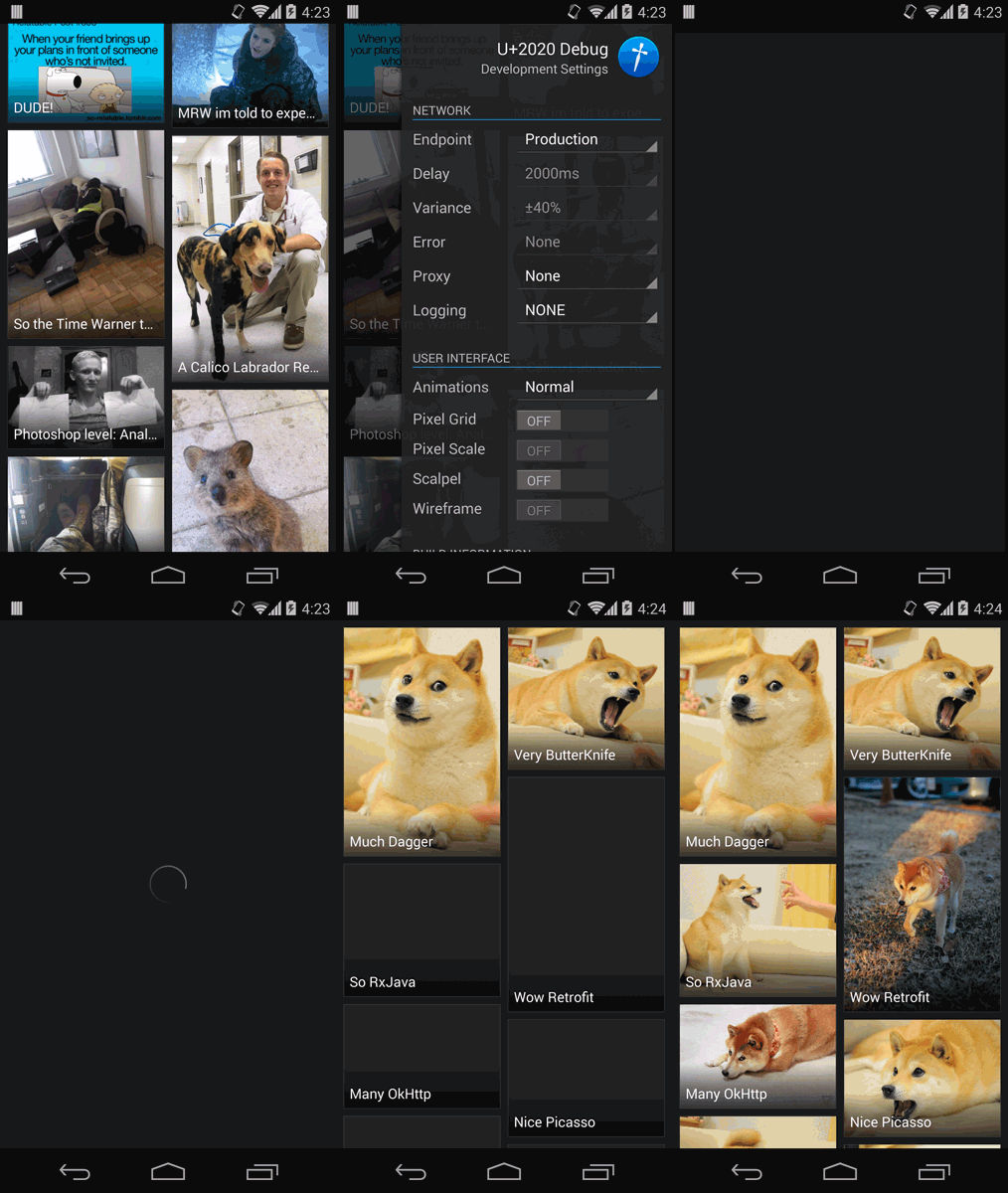
Through the use of Dagger overrides, the 'debug' version of the app adds a slew of debugging
features to the app which are presented in the Debug Drawer™. The drawer is opened by a bezel
swipe from the right of the screen. From here you can change and view all of the developer options
of the application.
The drawer is provided by the simple interface ViewContainer. This is an indirection that the
single activity uses to fetch its container into which it can place its content. The default
implementation returns the Android-provided content view. The 'debug' version overrides this with
DebugViewContainer which is responsible for creating the drawer, adding it to the activity, and
returning its content view group. It also injects all of the developer objects and binds them to
controls in the drawer.
The most notable feature the 'debug' version exposes is the concept of endpoints. Using the spinner
at the top of the drawer, you can change the endpoint to which the app communicates. We also expose
a false endpoint named "Mock Mode" which simulates an in-memory server inside the app. This "Mock
Mode" eases manual testing and also provides a static set of data to write instrumentation tests
against.
"Mock Mode" can be queried when modules are configuring their dependencies which is what allows
simulating the remote server in-memory.
@Singleton class MockFoo() {
  @Inject MockFoo() {}
  // ...
}
See DebugDataModule and DebugApiModule to see this in action in the real app.
The mock implementations of these types are some of those injected into the DebugViewContainer for
binding in the drawer. This allows us to do things like control their fake network behavior and
alter their behavior.
In order to keep the shared state which represents the server-side data we use a ServerDatabase
singleton. At present this is only done with a combination of in-memory collections and images in
the debug/assets/. In a more complex app you could even use a full database. This class is
injected into each mock service which uses its methods to query and mutate state
(e.g., MockGalleryService).
Something with animations to showcase animation control.
Network errors probably crash the app.
Add another part of the app other than 'trending' so we can demo child graphs.
License
Copyright 2014 Jake Wharton

Licensed under the Apache License, Version 2.0 (the "License");
you may not use this file except in compliance with the License.
You may obtain a copy of the License at

   http://www.apache.org/licenses/LICENSE-2.0

Unless required by applicable law or agreed to in writing, software
distributed under the License is distributed on an "AS IS" BASIS,
WITHOUT WARRANTIES OR CONDITIONS OF ANY KIND, either express or implied.
See the License for the specific language governing permissions and
limitations under the License.
Yes — JakeWharton/u2020 ships under the Apache-2.0 license, which makes its source code freely readable (and, depending on license terms, forkable and reusable). Source: github.com/JakeWharton/u2020.
What is JakeWharton/u2020?
JakeWharton/u2020 (JakeWharton/u2020) is a Java project on GitHub. From the project's own README: A sample Android app which showcases advanced usage of Dagger among other open source libraries.
What license does JakeWharton/u2020 use?
JakeWharton/u2020 is released under the Apache-2.0 license. Always verify the LICENSE file directly on GitHub for the authoritative terms — license strings can be edited out of sync with a project's actual stance.
Where can I see JakeWharton/u2020 in action?
The project maintains a homepage at https://www.youtube.com/watch?v=0XHx9jtxIxU. The README tab on this page also usually contains screenshots and a quickstart.
Where do I read more about JakeWharton/u2020?
This TopGit page is a snapshot — the READ ME tab shows the project's own README content (links stripped, images preserved). The GitHub repository at github.com/JakeWharton/u2020 is the definitive source.
Read full README in the tab above.
Curious whether u2020 is right for you?
Let ChatGPT, Claude, or Perplexity look into it — click below and see what AI actually says about u2020.

 /u2020