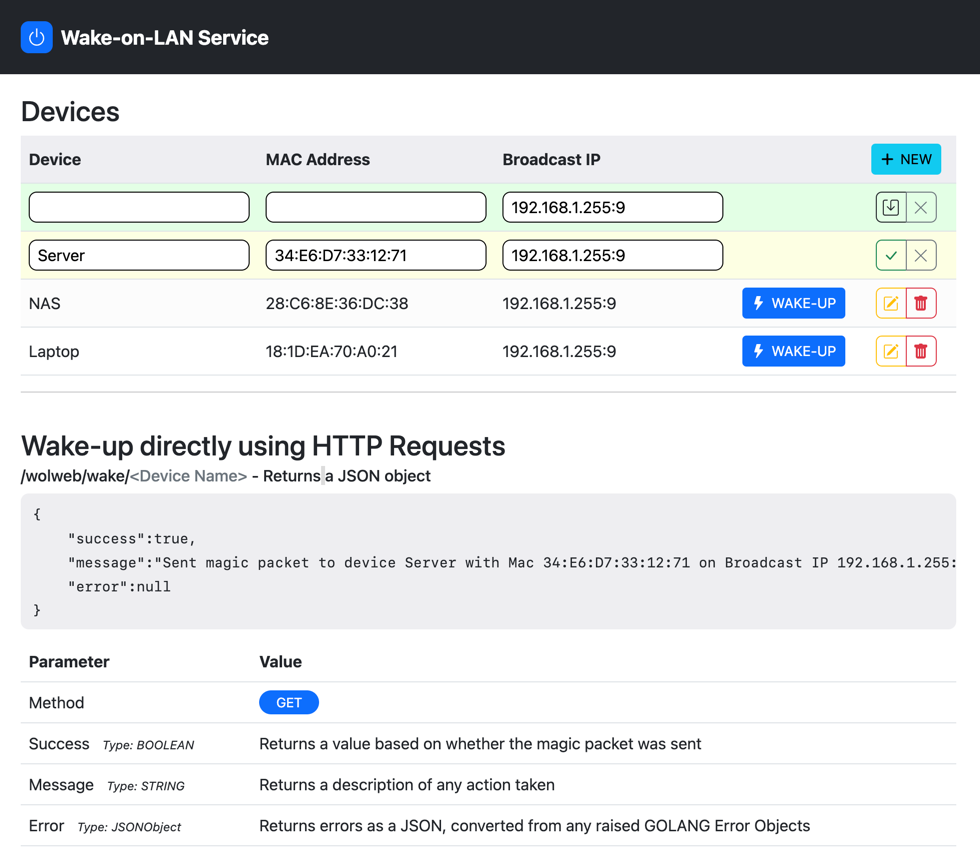
juanfont/wolweb — 3★ on GitHub. Web interface for sending Wake-on-lan (magic packet). An HTTP server built using GoLang and uses Bootstrap for UI.
Snapshot summary built from the project's own GitHub metadata — there's no written TopGit review yet. The page will update automatically when a full review is published.
WHY NO REVIEW YET
TopGit writes full reviews for the most-starred, most-requested repositories. This page is a snapshot until then — see the READ ME tab for the original README in full.
Web interface for sending Wake-on-LAN (Magic Packet)
A GoLang based HTTP server which will send a Wake-on-LAN package (magic packet) on a local network. The request can be send using web interface or directly using HTTP request with the mapped device name in the URL. The only computing device I have running 24x7 is handy-dandy Raspberry Pi 4 (4GB) with docker containers. All other devices like server, laptop and NAS as powered only when I need them. I needed a way to easily turn them on specifically when trying to automate things like nightly builds.
This application is intended do be used in conjunction with a reverse proxy and secured with an SSL certificate. As the intended use case was with home networks, the application has no in-built authentication. While this could pose a slight security risk even if this was hacked to application is intended to be containerised so the attack surface if limited.
I have bookmarked direct link to device(s) on my browsers to wake them using single HTTP call for ease of access.
Use cases:
Wake-up my home computers remotely, for access remotely over RDP.
Integration with automated routines to allow parts of a home lab to sleep instead of running 24x7 to save energy.
Configuring WOL
On some devices WOL can be difficult to correctly configure and have work reliably.
Follow this article for Dell Laptops.
Bootstrap UI with JS Grid for editing data
The UI features CRUD operation implemented using js-grid.com plugin.
Wake-up directly using HTTP Request
/wolweb/wake/<hostname> - Returns a JSON object
{
  "success": true,
  "message": "Sent magic packet to device Server with Mac 34:E6:D7:33:12:71 on Broadcast IP 192.168.1.255:9",
  "error": null
}
Configure the app
The application will use the following default values if they are not explicitly configured as explained in sections below.
Config
Description
Default
Host
Define the host address on which the webserver will listen
0.0.0.0
Port
Define the port on which the webserver will listen
8089
Virtual Directory
A virtual directory to mount this application under
/wolweb
Broadcast IP and Port
This is broadcast IP address and port for the local network. Please include the port :9
192.168.1.255:9
You can override the default application configuration by using a config file or by setting environment variables. The application will first load values from config file and look for environment variables and overwrites values from the file with the values which were found in the environment.
This project includes Dockerfile (based on Alpine) and docker-compose.yml files which you can use to build the image for your platform and run it using the docker compose file. If interested, I also have alternate Dockerfile (based on Debian). Both of these Dockerfile are tested to run on Raspberry Pi Docker CE. If you want to use this application as-is, you will only need to download these two docker-related files to get started. The docker file will grab the code and compile it for your platform.
I could not get this to run using Docker's bridged network. The only way I was able to make it work was to use host network for the docker container. See this https://github.com/docker/for-linux/issues/637 for details.
I initially thought of running this application on my router, so I needed to build the application without having to install build tool on my router. I use the following PowerShell one liner to build targeting the ARM v5 platform on my Windows machine with VS Code:
Copy the file over to router and make it executable.
chmod +x wolweb
To see detailed instructions on how to run this application as service on ASUS router with custom firmware asuswrt-merlin see this Wiki guide
NGiNX Config
I am already using NGiNX as web-proxy for accessing multiple services (web interfaces) from single IP and port 443 using free Let's Encrypt HTTPS certificate. For accessing this service, I just added the following configuration under my existing server node.
This is also the reason why I have an option in this application to use virtual directory /wolweb as I can easily map all requests for this application. My / is already occupied for other web application in my network.
Credits
This project is based on a couple of framworks and provided below:
https://github.com/dabondi/go-rest-wol - Provided the initial project framework
https://github.com/sabhiram/go-wol - Provided the functionality to the REST
Thank you to the developers behind both projects, David Baumann and Shaba Abhiram!
License
Distributed with GNU General Public License (c) 2023
TopGit's last sync did not record any GitHub topics for juanfont/wolweb. GitHub topics appear in the right sidebar of a repository page; that's the authoritative place to check.
How active is development on juanfont/wolweb?
The most recent commit recorded on juanfont/wolweb was 3.3 years ago, based on the GitHub push timestamp. The repository has 1 forks — one of the better signals of community interest.
How many stars does juanfont/wolweb have?
juanfont/wolweb has 3 GitHub stars — refresh the page for the live number, or check github.com/juanfont/wolweb. TopGit mirrors GitHub's count but does not claim minute-by-minute accuracy.
What is juanfont/wolweb?
juanfont/wolweb (juanfont/wolweb) is a multi-language project on GitHub. From the project's own README: Web interface for sending Wake-on-lan (magic packet). An HTTP server built using GoLang and uses Bootstrap for UI.
What language is juanfont/wolweb written in?
TopGit's last sync did not record a primary language for juanfont/wolweb. Open the repository on GitHub to see the full breakdown by file extension.
Read full README in the tab above.
Want a second opinion on wolweb?
Ask an AI that can read this page — one click and you get its take on wolweb.

 /wolweb