sampotts/nativefier — an open-source project — sits at 4 GitHub stars. Make any web page a desktop application
Snapshot summary built from the project's own GitHub metadata — there's no written TopGit review yet. The page will update automatically when a full review is published.
WHY NO REVIEW YET
TopGit writes full reviews for the most-starred, most-requested repositories. This page is a snapshot until then — see the READ ME tab for the original README in full.
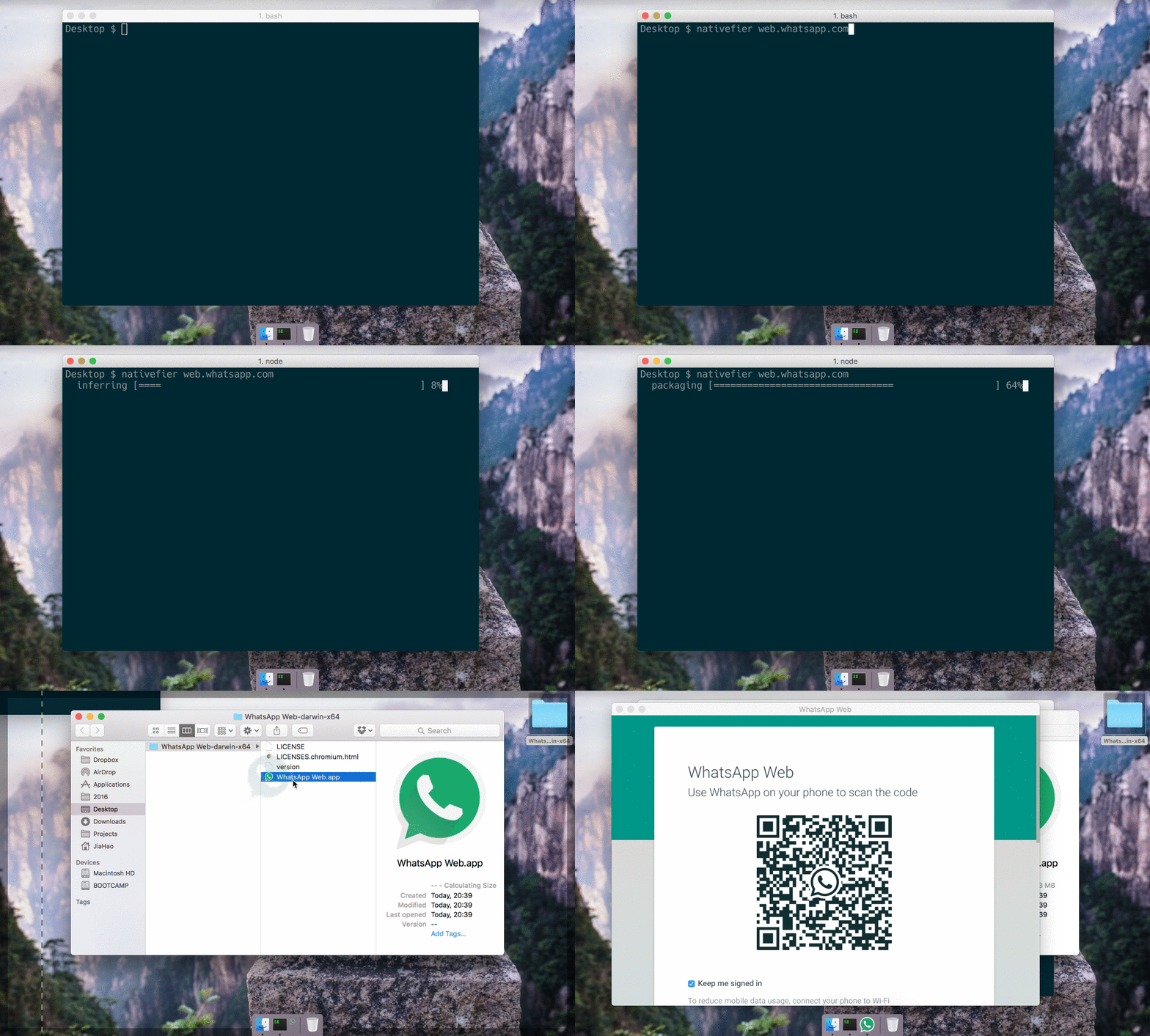
You want to make a native wrapper for WhatsApp Web (or any web page).
nativefier 'web.whatsapp.com'
You're done.
Introduction
Nativefier is a command-line tool to easily create a desktop app for any web site
with minimal configuration. Apps are wrapped by Electron
(which uses Chromium under the hood) in an OS executable (.app, .exe, etc)
for use on Windows, macOS and Linux.
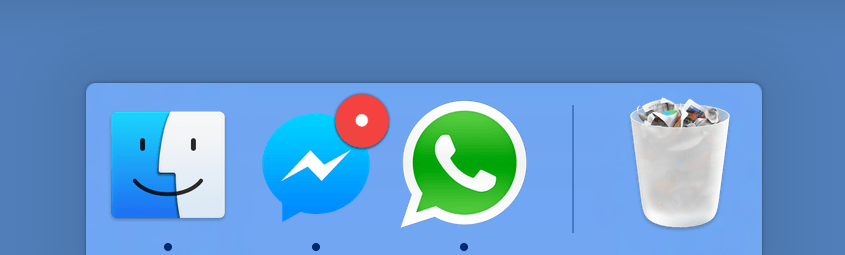
I did this because I was tired of having to ⌘-tab or alt-tab to my browser and then search
through the numerous open tabs when I was using Facebook Messenger or
Whatsapp Web (HN thread). Nativefier features:
Automatically retrieval of app icon / name.
JavaScript and CSS injection.
Many more, see the API docs or nativefier --help
Installation
macOS 10.9+ / Windows / Linux
Node.js >= 12.9 and npm >= 6.9
Optional dependencies:
ImageMagick or GraphicsMagick to convert icons.
Make sure convert and identify or gm are in your system $PATH.
Wine to package Windows apps under non-Windows platforms.
Make sure wine is in your system $PATH.
Then, install Nativefier globally with npm install -g nativefier
Usage
To create a native desktop app for medium.com,
simply nativefier "medium.com"
Nativefier will try to determine the app name, and well as lots of other options.
If desired, these options can be overwritten. For example, to override the name,
nativefier --name 'My Medium App' 'medium.com'
Read the API documentation or run nativefier --help
to learn about other command-line flags usable to configure the packaged app.
To have high-resolution icons used by default for an app/domain, please
contribute to the icon repository!
Build Commands Catalog
For a list of build commands contributed by the nativefier community take a look at the CATALOG.md file
Usage with Docker
Nativefier is also usable from Docker.
Pull the latest stable image from Docker Hub: docker pull nativefier/nativefier
... or build the image yourself: docker build -t local/nativefier .
(in this case, replace nativefier/ in the below examples with local/)
By default, the command nativefier --help will be executed.
To build e.g. a Gmail nativefier app to a writable local ~/nativefier-apps,
docker run --rm -v ~/nativefier-apps:/target/ nativefier/nativefier https://mail.google.com/ /target/
You can pass Nativefier flags, and mount volumes to provide local files. For example, to use an icon,
docker run --rm -v ~/my-icons-folder/:/src -v $TARGET-PATH:/target nativefier/nativefier --icon /src/icon.png --name whatsApp -p linux -a x64 https://web.whatsapp.com/ /target/
Development
Help welcome on bugs and
feature requests.
Developer / build docs, API documentation,
Changelog.
License
MIT
Troubleshooting
Before submitting a question or bug report, please ensure you have read through these common issues and see if you can resolve the problem on your own. If you still encounter issues after trying these steps, or you don't see something similar to your issue listed, please submit a bug report.
Take a look a the Build Command Catalog as a working command for your application may already exist there.
I am trying to use Nativefier to build an app for a site that tells me I have an old/unsupported browser.
This issue comes up for sites that do not wish to support an app made with Nativefier or similar technologies (such as Google and WhatsApp)
Troubleshooting Steps
First try setting the --user-agent to something different. Try using the value you would get at [https://www.whatismybrowser.com/detect/what-is-my-user-agent] and use your current browser's user agent.
If this doesn't work, the site (such as WhatsApp) may be using a service worker to analyze the app and detect. You can disable the service worker cache by doing the following, which is a known fix for WhatsApp:
Create a javascript file containing the following snippet:
if ('serviceWorker' in navigator) {
    caches.keys().then(function (cacheNames) {
        cacheNames.forEach(function (cacheName) {
            caches.delete(cacheName);
        });
    });
}
Inject the javascript file into your app when generating it with the --inject argument.
I am trying to use Nativefier to build an app for a site with video, but the video won't play.
This issue comes up for certain sites like HBO Max and Udemy.
Troubleshooting Steps
First try using the --widevine argument when building the app. This uses the Castlabs version of Electron which allows the playback of DRM enabled video.
If this doesn't work, the site may require your app to be signed for --widevine to work. See the Castlabs documentation on using their application signing service to sign the application.
I am trying different options to Nativefier to experiment with, but noticing that sometimes things cache between rebuilds of my app.
This issue can occur because the cache of the app and the app itself are kept separate by default. You can try clearing out the cache.
Troubleshooting Steps
Delete your app's cache, which can be found under the folder <your_app_name_lower_case>-nativefier-<random_id> in your OS's app data directory
<your_app_name_lower_case> represents the lowercase version of your app's name. E.g., GitHub would be github.
<random_id> represents a randomly generated id for your app. Open the containing folder to see what it may be.
For Linux, the app data directory is $XDG_CONFIG_HOME or ~/.config
For MacOS, the app data directory is ~/Library/Application\ Support/
No homepage URL was recorded for sampotts/nativefier in TopGit's last sync. The README tab above frequently contains screenshots and demo links, or check the repository description on GitHub.
Does sampotts/nativefier have any tags?
TopGit's last sync did not record any GitHub topics for sampotts/nativefier. GitHub topics appear in the right sidebar of a repository page; that's the authoritative place to check.
How active is development on sampotts/nativefier?
The most recent commit recorded on sampotts/nativefier was 5.4 years ago, based on the GitHub push timestamp. The repository has 0 forks — one of the better signals of community interest.
Is sampotts/nativefier open source?
Yes — sampotts/nativefier ships under the MIT license, which makes its source code freely readable (and, depending on license terms, forkable and reusable). Source: github.com/sampotts/nativefier.
What license does sampotts/nativefier use?
sampotts/nativefier is released under the MIT license. Always verify the LICENSE file directly on GitHub for the authoritative terms — license strings can be edited out of sync with a project's actual stance.
Where do I read more about sampotts/nativefier?
This TopGit page is a snapshot — the READ ME tab shows the project's own README content (links stripped, images preserved). The GitHub repository at github.com/sampotts/nativefier is the definitive source.
Read full README in the tab above.
Is nativefier worth your time?
ChatGPT, Claude and Perplexity can all read this page. Ask one of them what it makes of nativefier.

 /nativefier