5.7k GitHub stars and counting — yeemachine/kalidokit is a TypeScript project TopGit is tracking across repositories on the platform. Blendshape and kinematics calculator for Mediapipe/Tensorflow.js Face, Eyes, Pose, and Finger tracking models.
Snapshot summary built from the project's own GitHub metadata — there's no written TopGit review yet. The page will update automatically when a full review is published.
WHY NO REVIEW YET
TopGit writes full reviews for the most-starred, most-requested repositories. This page is a snapshot until then — see the READ ME tab for the original README in full.
:exclamation: KalidoKit is now officially deprecated and solutions will be directly integrated into MediaPipe :exclamation:
Face, Pose, and Hand Tracking Calculator
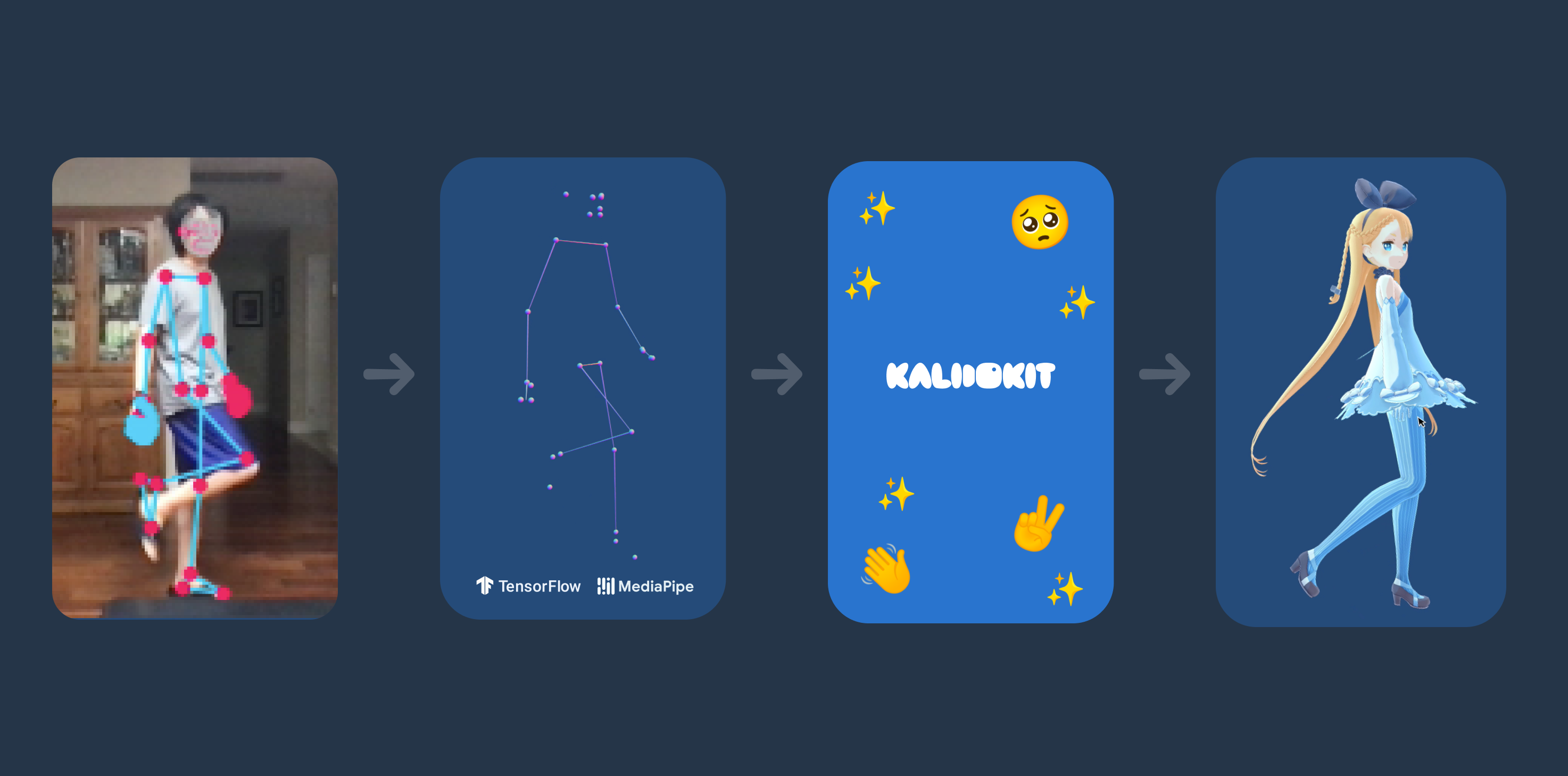
Kalidokit is a blendshape and kinematics solver for Mediapipe/Tensorflow.js face, eyes, pose, and hand tracking models, compatible with Facemesh, Blazepose, Handpose, and Holistic. It takes predicted 3D landmarks and calculates simple euler rotations and blendshape face values.
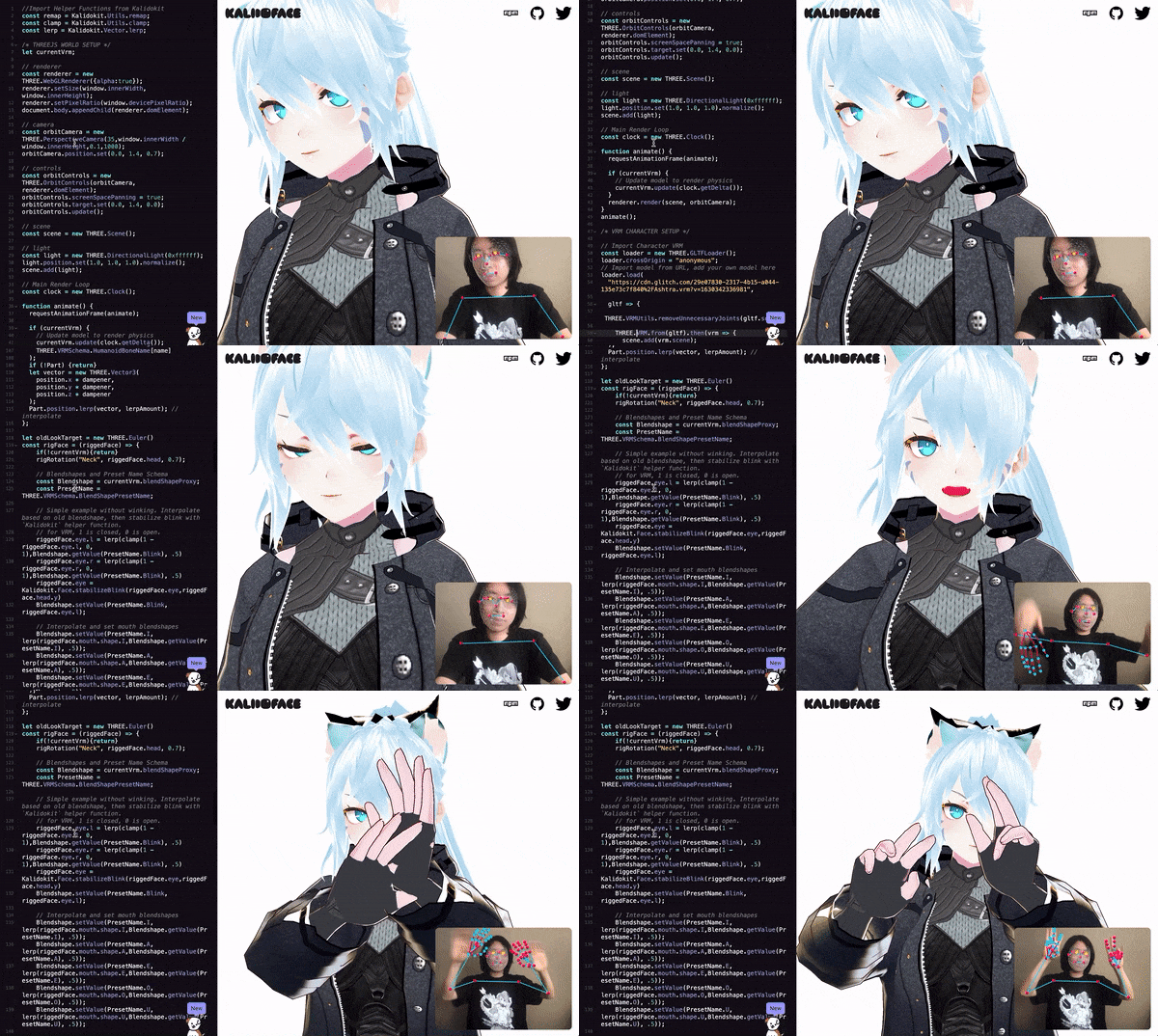
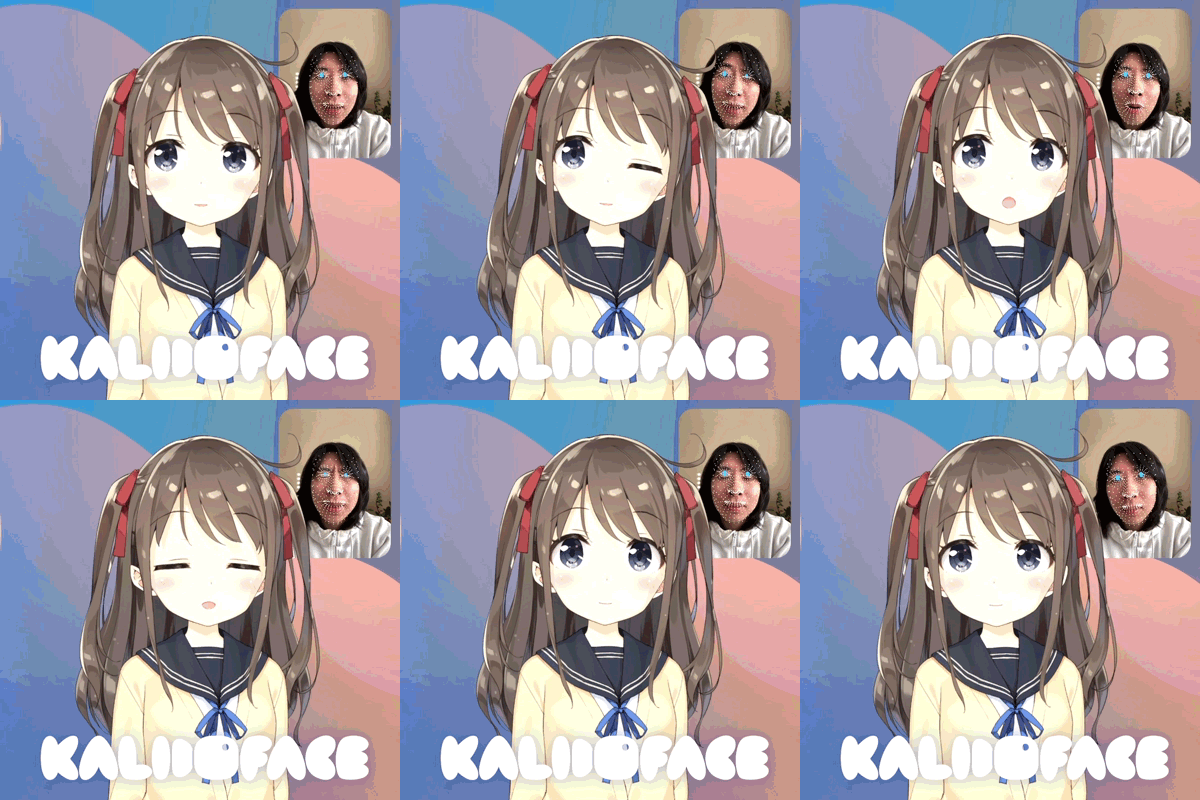
As the core to Vtuber web apps, Kalidoface and Kalidoface 3D, KalidoKit is designed specifically for rigging 3D VRM models and Live2D avatars!
NOTE: This is a JS library meant for developers using Mediapipe pretrained models and not a complete app by itself. Please visit Kalidoface for the full vtuber experience 😉!
Install
Via NPM
npm install kalidokit
import * as Kalidokit from "kalidokit";

// or only import the class you need

import { Face, Pose, Hand } from "kalidokit";
Kalidokit is composed of 3 classes for Face, Pose, and Hand calculations. They accept landmark outputs from models like Facemesh, Blazepose, Handpose, and Holistic.
// Accepts an array(468 or 478 with iris tracking) of vectors
Kalidokit.Face.solve(facelandmarkArray, {
    runtime: "tfjs", // `mediapipe` or `tfjs`
    video: HTMLVideoElement,
    imageSize: { height: 0, width: 0 },
    smoothBlink: false, // smooth left and right eye blink delays
    blinkSettings: [0.25, 0.75], // adjust upper and lower bound blink sensitivity
});

// Accepts arrays(33) of Pose keypoints and 3D Pose keypoints
Kalidokit.Pose.solve(poseWorld3DArray, poseLandmarkArray, {
    runtime: "tfjs", // `mediapipe` or `tfjs`
    video: HTMLVideoElement,
    imageSize: { height: 0, width: 0 },
    enableLegs: true,
});

// Accepts array(21) of hand landmark vectors; specify 'Right' or 'Left' side
Kalidokit.Hand.solve(handLandmarkArray, "Right");

// Using exported classes directly
Face.solve(facelandmarkArray);
Pose.solve(poseWorld3DArray, poseLandmarkArray);
Hand.solve(handLandmarkArray, "Right");
Additional Utils
// Stabilizes left/right blink delays + wink by providing blenshapes and head rotation
Kalidokit.Face.stabilizeBlink(
    { r: 0, l: 1 }, // left and right eye blendshape values
    headRotationY, // head rotation in radians
    {
        noWink = false, // disables winking
        maxRot = 0.5 // max head rotation in radians before interpolating obscured eyes
    });

// The internal vector math class
Kalidokit.Vector();
VRM and Live2D Sample Code
Quick-start your Vtuber app with these simple remixable examples.
VRM Glitch Template
Face, full-body, and hand tracking in under 350 lines of javascript. This demo uses Mediapipe Holistic for body tracking, Three.js + Three-VRM for rendering models, and KalidoKit for the kinematic calculations. This demo uses a minimal amount of easing to smooth animations, but feel free to make it your own! VRM model from Vroid Hub.
Live2D Glitch Template
This demo uses Mediapipe FaceMesh for face tracking, Pixi.js + pixi-live2d-display for rendering models, and KalidoKit for the kinematic calculations. This demo uses an official sample Live2D model, Hiyori.
Local VRM and Live2D Examples
Interested in contributing? If you clone this project, the docs folder includes both VRM and Live2D KalidoKit templates. Run the test script to build the library and start up the dev server. The VRM demo will be hosted on localhost:3000 and Live2D on localhost:3000/live2d/.
npm install
npm run test
Basic Usage
The implementation may vary depending on what pose and face detection model you choose to use, but the principle is still the same. This example uses Mediapipe Holistic which concisely combines them together.
import * as Kalidokit from 'kalidokit'
import '@mediapipe/holistic/holistic';
import '@mediapipe/camera_utils/camera_utils';

let holistic = new Holistic({locateFile: (file) => {
    return `https://cdn.jsdelivr.net/npm/@mediapipe/[email protected]/${file}`;
}});

holistic.onResults(results=>{
    // do something with prediction results
    // landmark names may change depending on TFJS/Mediapipe model version
    let facelm = results.faceLandmarks;
    let poselm = results.poseLandmarks;
    let poselm3D = results.ea;
    let rightHandlm = results.rightHandLandmarks;
    let leftHandlm = results.leftHandLandmarks;

    let faceRig = Kalidokit.Face.solve(facelm,{runtime:'mediapipe',video:HTMLVideoElement})
    let poseRig = Kalidokit.Pose.solve(poselm3d,poselm,{runtime:'mediapipe',video:HTMLVideoElement})
    let rightHandRig = Kalidokit.Hand.solve(rightHandlm,"Right")
    let leftHandRig = Kalidokit.Hand.solve(leftHandlm,"Left")

    };
});

// use Mediapipe's webcam utils to send video to holistic every frame
const camera = new Camera(HTMLVideoElement, {
  onFrame: async () => {
    await holistic.send({image: HTMLVideoElement});
  },
  width: 640,
  height: 480
});
camera.start();
Slight differences with Mediapipe and Tensorflow.js
Due to slight differences in the results from Mediapipe and Tensorflow.js, it is recommended to specify which runtime version you are using as well as the video input/image size as a reference.
Kalidokit.Pose.solve(poselm3D,poselm,{
    runtime:'tfjs', // default is 'mediapipe'
    video: HTMLVideoElement,// specify an html video or manually set image size
    imageSize:{
        width: 640,
        height: 480,
    };
})

Kalidokit.Face.solve(facelm,{
    runtime:'mediapipe', // default is 'tfjs'
    video: HTMLVideoElement,// specify an html video or manually set image size
    imageSize:{
        width: 640,
        height: 480,
    };
})
Outputs
Below are the expected results from KalidoKit solvers.
If you'd like to share a creative use of KalidoKit, please reach out or send a pull request! Feel free to also use our Twitter hashtag, #kalidokit.
Kalidoface/KalidoKit also now has a Discord server! Come and join us!
The current library is a work in progress and contributions to improve it are very welcome! Some plans include: better facial blendshapes, full leg tracking, and improved efficiency.
How active is development on yeemachine/kalidokit?
The most recent commit recorded on yeemachine/kalidokit was 1.2 years ago, based on the GitHub push timestamp. The repository has 717 forks — one of the better signals of community interest.
Is yeemachine/kalidokit open source?
Yes — yeemachine/kalidokit ships under the MIT license, which makes its source code freely readable (and, depending on license terms, forkable and reusable). Source: github.com/yeemachine/kalidokit.
What license does yeemachine/kalidokit use?
yeemachine/kalidokit is released under the MIT license. Always verify the LICENSE file directly on GitHub for the authoritative terms — license strings can be edited out of sync with a project's actual stance.
What topics is yeemachine/kalidokit associated with?
GitHub's repository topics for yeemachine/kalidokit: "face-detection", "hand-detection", "mediapipe-facemesh", "mediapipe-hands", "mediapipe-pose", "pose-estimation", "tensorflowjs", "vtuber". TopGit's editorial category is open-source.
Where can I see yeemachine/kalidokit in action?
The project maintains a homepage at https://kalidoface.com. The README tab on this page also usually contains screenshots and a quickstart.
Where do I read more about yeemachine/kalidokit?
This TopGit page is a snapshot — the READ ME tab shows the project's own README content (links stripped, images preserved). The GitHub repository at github.com/yeemachine/kalidokit is the definitive source.
Read full README in the tab above.
Is kalidokit worth your time?
ChatGPT, Claude and Perplexity can all read this page. Ask one of them what it makes of kalidokit.

 /kalidokit